

Today marks a major change for landlords across England. The Renters Rights Act 2025 is now live, and the Section 8 notice has become far more important.
For landlords in Derbyshire and Staffordshire, this means a different approach to ending a tenancy. Section 21, often called no fault eviction, has been removed. Therefore, landlords now need a valid legal ground when they want possession.
This guide explains the key points in plain English. It does not replace legal advice. However, it should help landlords understand the new landscape before taking action.
What has changed for landlords from 1 May 2026?
From 1 May 2026, landlords will usually need to use the new Section 8 notice process if they want a tenant to leave. GOV UK guidance says landlords should use the grounds for possession that apply on and after this date. It also refers to the new Section 8 notice form, Form 3A. (GOV.UK)
In addition, the official GOV UK tenant overview says most existing assured shorthold tenancies became assured periodic tenancies on 1 May 2026. This is a major practical shift for landlords and tenants. (GOV.UK)
The key change is simple. Landlords now need to rely on a specific ground for possession. As a result, the reason for ending the tenancy matters more than ever.
Why the Section 8 notice now matters
A Section 8 notice tells the tenant which legal ground the landlord intends to rely on.
This means the notice must be accurate. The uploaded guidance warns that a valid Section 8 notice must be served under the Renters Rights Act. It also states that serving a defective notice is an offence.
That point is important. If a tenant leaves after receiving a notice, and the landlord used a ground they could not legally rely on, the landlord or agent may face a fine. The guidance says this risk can apply whether the error was negligent or deliberate.
Therefore, landlords should not treat Section 8 as a quick form filling exercise. Each ground needs evidence, timing, and careful checking.
Common Section 8 grounds landlords should understand
The full list of grounds is detailed. However, several will be especially relevant for private landlords.
Ground 1, landlord or family occupation
Ground 1 may apply where the landlord, their spouse or civil partner, or certain close family members wish to occupy the property.
The guidance table states that this ground requires four months notice. It also says companies and trusts cannot use it.
Landlords should take care here. The reason must be genuine, and the restriction on marketing or reletting can be significant.
Ground 1A, landlord intends to sell
Ground 1A may apply where the landlord wants to sell, or grant a lease of more than 21 years.
The guidance states that four months notice is required. It also warns that the landlord cannot market or re let the property from when notice is served, and continuing until 12 months after the notice expires.
As a result, landlords should plan carefully before using this ground. It may affect timing, marketing, and future letting plans.
Ground 8, severe rent arrears
Ground 8 covers severe rent arrears. The guidance states that this requires four weeks notice, and refers to three months arrears. It also notes that unpaid Universal Credit cannot be counted against arrears.
This is one of the most important grounds for landlords. However, rent records must be accurate and up to date.
Grounds 10 and 11, rent arrears and late payment
Ground 10 covers some rent arrears. Ground 11 covers persistent late payment of rent.
Both require four weeks notice, according to the uploaded guide.
These grounds may be useful where the arrears pattern is ongoing. However, landlords should keep a clear payment history and communication record.
Ground 12, breach of contract
Ground 12 may apply where the tenant has breached the tenancy agreement, other than rent arrears.
The guidance states that two weeks notice is required.
For example, this could involve a breach of a tenancy term. However, the facts and evidence will always matter.
Ground 14, nuisance or antisocial behaviour
Ground 14 covers nuisance, antisocial behaviour, or interference with management.
The uploaded guide states that no notice is required for this ground.
Even so, landlords should avoid rushed decisions. Evidence can include incident logs, police references, neighbour reports, and written communication.
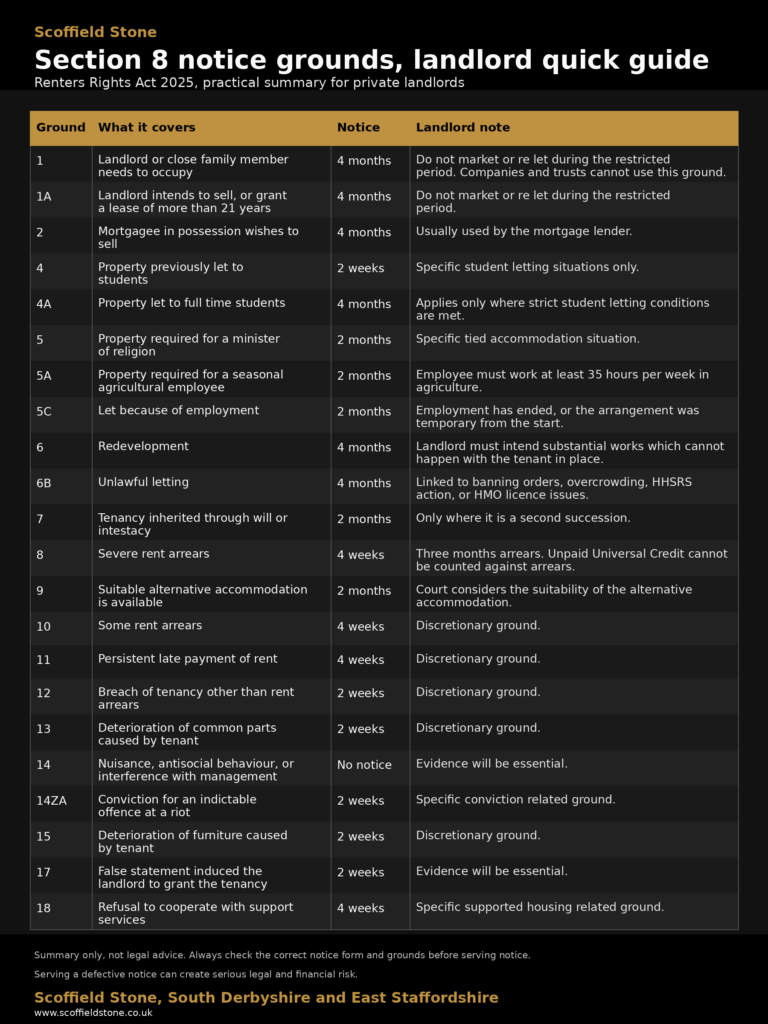
Scoffield Stone Section 8 notice quick guide
The table below gives a practical summary for landlords. It is not legal advice, and it should not replace checking the full statutory wording.
What landlords should do before serving notice
Before serving a Section 8 notice, landlords should pause and check the basics.
A good starting point is to ask:
- Which ground applies?
- Is the ground mandatory or discretionary?
- What evidence supports that ground?
- What notice period applies?
- Is the correct form being used?
- Has the tenant received all required information?
- Would legal advice reduce risk?
In addition, landlords should keep a full paper trail. This may include the tenancy agreement, rent schedule, inspection reports, photographs, messages, and complaint records.
Why getting the notice wrong can be costly
A defective notice can delay possession. However, under the new rules, the risk may go further.
The uploaded guidance says serving a defective notice is an offence. It also says a landlord or agent can be fined if a tenant leaves after receiving a notice based on grounds they could not legally rely on.
Therefore, landlords should take extra care from the start. A rushed notice may seem quicker, but it can create more problems later.
How Scoffield Stone can help landlords
Scoffield Stone helps landlords across South Derbyshire and East Staffordshire manage their rental property with care.
We can help you review the situation, check the practical next steps, and decide whether specialist legal support is needed. Also, we can help with rent records, communication, tenancy management, and preparation for future letting.
If you are unsure about your position, speak to us before taking action. Early advice often prevents avoidable mistakes.
FAQ
Can landlords still use Section 21?
No, Section 21 has been removed under the new Renters Rights Act framework. Landlords now need to rely on the correct possession ground.
Does every Section 8 ground have the same notice period?
No. Notice periods vary. For example, some grounds require four months, some require four weeks, and Ground 14 has no notice period.
Can I use Section 8 because I want to sell my rental property?
Possibly. Ground 1A may apply where a landlord intends to sell. However, restrictions can apply, so landlords should take advice first.
What happens if I serve the wrong notice?
You may face delay, cost, and enforcement risk. The uploaded guidance warns that serving a defective notice is an offence.
Should I get legal advice before serving a Section 8 notice?
Yes, in many cases. The new rules carry risk, especially if the tenant leaves before the case reaches court.
Conclusion
The Renters Rights Act 2025 changes the way landlords regain possession.
From today, the Section 8 notice is central to the process. However, it must be used correctly, with the right ground, notice period, and supporting evidence.
If you are a landlord in Hilton, Burton upon Trent, Repton, Etwall, Willington, Tutbury, Mickleover, Derby, or the surrounding area, Scoffield Stone can help you take the next sensible step.
To discuss your rental property, contact Scoffield Stone or book a rental appraisal today.